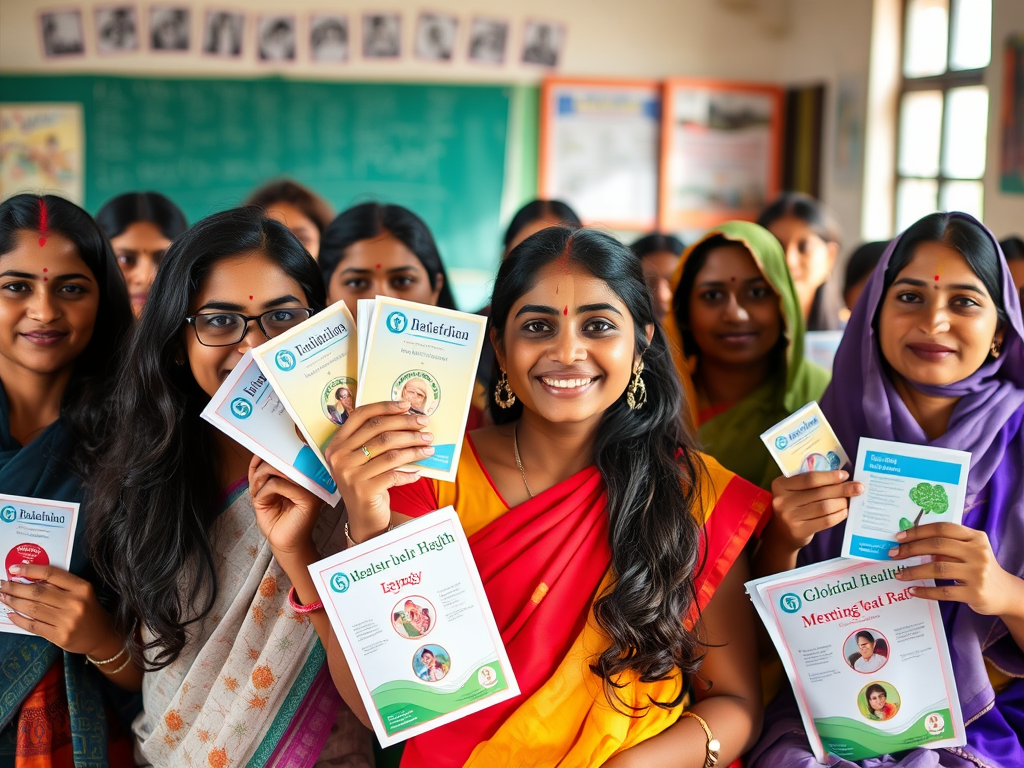
Menstrual health is a critical yet persistently under-addressed issue in India, intersecting public health, gender justice, education, and labour participation. Period poverty is lack of access to safe menstrual products, sanitation, information, and dignified conditions affects an estimated ~23% of Indian girls who drop out of school after menarche and disproportionately burdens women in low-income, rural, tribal, and informal work settings. Despite policy efforts such as the Menstrual Hygiene Scheme (MHS) and the Free Sanitary Pad initiatives under NHM, India’s approach remains fragmented, uneven across states, and overly reliant on behavioural change rhetoric rather than the structural guarantees. This paper analyses India’s menstrual health policy through the Intervention Ladder, identifying gaps and proposing implementable reforms.

15-24 years using period products in India’s states. Seventeen states and Union Territories (UTs) had 90% or more of their women using period products; in Puducherry and the Andaman and Nicobar Islands, the fraction was 99%.


Gujarat and Meghalaya were the only two states with 65% of women using period products. And Mizoram is the only state where usage decreased from 93.4% to 89.4%. Thus, there is a need for action in these three states to improve period-product use.
Moving Towards Robust Regulation
This article supports state intervention but argues for a shift upward on the Intervention Ladder from the rhetorical and nudging approaches towards the robust regulation, fiscal commitment, and partial state provisioning. Menstrual health cannot be treated as a matter of a personal choice alone; it is a public good with the intergenerational consequences, warranting the stronger governmental responsibility.
Intervention Ladder Analysis
- Do Nothing (Strategic Inaction) – Historically, menstruation was relegated to the private sphere, with the minimal state engagement. This inaction supported stigma, unsafe practices, and health risks such as RTIs and anemia as well. The inaction cost remains visible in NFHS-5 data, showing persistent menstrual hygiene inequities across the caste and income lines. Demonstrating inaction is harmful.
- Rhetoric and Signalling – Govt campaigns like Swachh Bharat and Beti Bachao Beti Padhao have included menstrual hygiene messaging. While these efforts normalised public discourse, rhetoric without material backing risks the symbolic compliance. Studies note that awareness alone does not translate into access where affordability and infrastructure are absent.
- Nudge and Behavioural Change – School-based menstrual education and ASHA-led counselling represent the low-coercion nudges. These improved knowledge but face the limits in patriarchal settings where girls lack decision-making power. Behavioural nudges are necessary but insufficient when structural deprivation constrains choice.
- Acting as Umpire (Regulation) – India regulates menstrual products through BIS standards and removed GST on sanitary napkins in 2018. However, the regulatory oversight of quality in the low-cost products remains weak, and the reusable alternatives lack the standardised safety certification. The state’s umpiring role is present but then under-enforced.
- Marginal Incentive Changes – Subsidised pads under MHS (₹1–6 per pad) marginally reduce cost barriers. Yet the supply chain gaps and the inconsistent last-mile delivery dilutes the impact. Marginal incentives work only when the administrative capacity is strong and currently uneven across states.
- Drastic Incentive Changes – Some states (e.g., Tamil Nadu, Kerala) provide the free universal access to menstrual products in the schools and colleges. Evidence suggests the higher attendance and retention. This also demonstrates that the stronger fiscal incentives can rapidly alter the outcomes when urgency is actually high.
 Change or Reassign Ownership – Self-help group (SHG)-led pad production units (supported by the NRLM) partially shift the ownership to community collectives. While actually empowering, quality control and the market access remain challenges. This hybrid model shows promise but it needs stronger state stewardship. A UNFPA‑WaterAid report on the menstrual hygiene products notes that the several Indian states have involved self‑help groups (SHGs) in the decentralized sanitary pad production, with support for production and distribution models that reach communities. The Nari Swabhiman SHG in Madhya Pradesh scaled its sanitary pad production with an NRLM loan to promote menstrual hygiene and economic empowerment.
- Do It Yourself (DIY State) – Complete state provisioning free menstrual products in public schools, prisons, shelters, and worksites exists in pockets but lacks national standardisation. Given menstruation’s link to education and health outcomes, selective DIY intervention is justified. The Scheme for Promotion of Menstrual Hygiene under the National Health Mission (NHM) focuses on increasing access & affordability of menstrual products (including subsidised or free sanitary napkins distributed via ASHAs and community/school platforms). For instance, Odisha’s Khushi Scheme provides free sanitary pads to girl students in schools, while Kerala’s She Pad Project supplies pads and menstrual hygiene facilities to government and aided schools.
Actionable Recommendations
- National Menstrual Health Guarantee– Expanding the existing NHM Menstrual Hygiene Scheme into a right-based model, ensuring free menstrual products and WASH facilities (toilets, water points, private disposal, incinerators) in schools, health centres, shelters, and other public sites, moving beyond discretionary schemes.
- Menstrual Leave and Workplace Support- Proposes mandatory menstrual leave and accessible menstruation-friendly facilities in both formal and informal sectors. State examples like Karnataka show feasibility. This reduces gender-linked absenteeism and promotes health and productivity.
- Quality Standards for Products- Ensures a safe, hygienic, and sustainable products under the BIS certification (IS 17514:2021), covering disposable and reusable options. Transparency in the testing and the certification empowers the users to make an informed choices.
- Dedicated Budget for Menstrual Health- Current funding is minimal and fragmented (<1% of health spending). A ring-fenced budget ensures resources for products, infrastructure, education, outreach, and monitoring, improving accountability and impact.
- Integrated Monitoring and Data Systems- Links the Health, Education, Labour, and Finance data through a real-time dashboard, tracking the product distribution, WASH access, absenteeism, and also program effectiveness, reducing silos and improving the policy decisions.
- Holistic Approach- Combining the guaranteed access, workplace support, quality standards, dedicated the funding, and the monitoring ensures that the menstrual health is treated as a right, not as a privilege, fostering the equity across all of the sectors like – education, health, and the labour sectors.
Menstrual health policy in India shows “where the State steps back, inequality steps in” inaction and symbolism alone have reproduced the caste, class, and gendered deprivation. As Amartya Sen reminds us, “freedom requires enabling conditions,” and only by moving decisively up the intervention ladder from nudges and regulation to ownership change and selective state provision can period poverty be treated not as charity, but as a matter of public justice and capability.