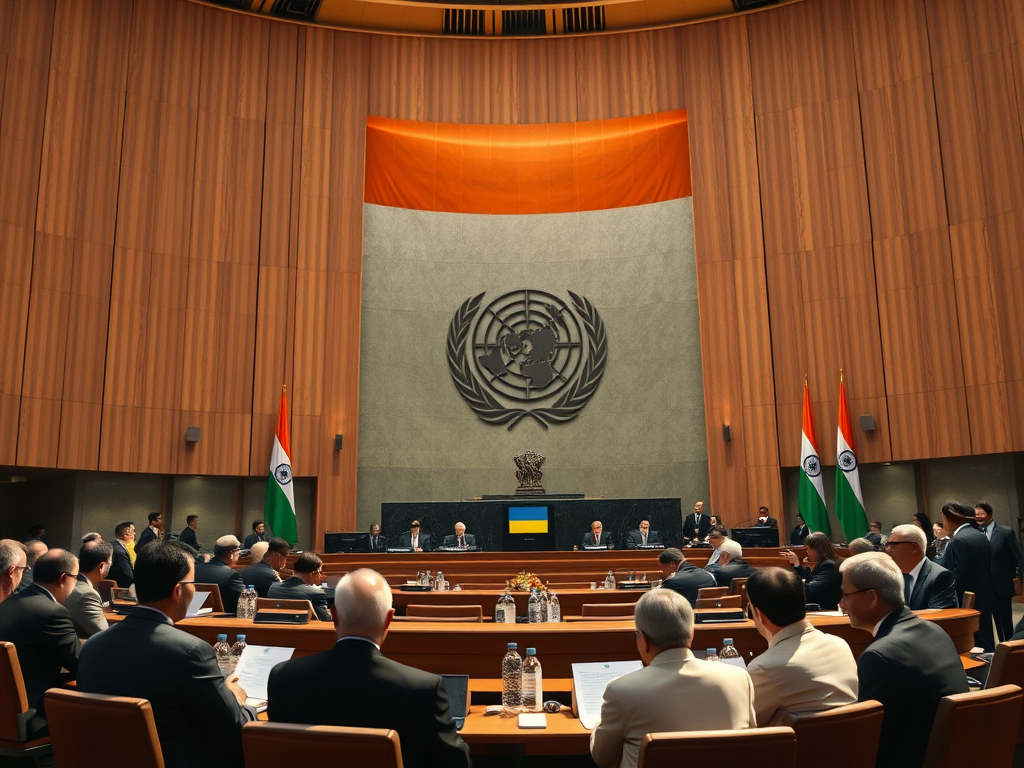
The United Nations was established in 1945 under the Charter of the United Nations. The General Assembly occupies a central position as the chief deliberative, policymaking and representative organ of the United Nations. Comprised of all 193 Members of the United Nations, it provides a unique forum for multilateral discussion of the full spectrum of international issues covered by the Charter. It also plays a central role in the process of standard-setting and the codification of international law. Each of the 193 Member States in the Assembly has one vote. Votes taken on designated important issues such as recommendations on peace and security, the election of Security Council and Economic and Social Council members, and budgetary questions require a two-thirds majority of Member States, but other questions are decided by a simple majority . Voting behaviour reflects the nation’s foreign policy, its priority towards an issue in the world and its position on whether it is yes or no or abstentions. Indian foreign policy has shifted from non-alignment during the Cold War to strategic autonomy in the post-Cold War era, and now, to multi-alignment. India’s voting behaviour at the United Nations has undergone a significant transformation, with the share of abstentions touching an all-time high in 2025. An analysis of over 5,500 resolutions between 1946 and June 2025 reveals that the proportion of ‘yes’ votes by India has fallen to 56%, the lowest since 1955, while abstentions have surged to 44%.
HISTORICAL BACKGROUND: FROM NON-ALIGNMENT TO STRATEGIC AUTONOMY
The UN behaviour of India goes back to non-alignment (NAM), where decolonisation and the interests of the Global South were put first in the Cold War (1946-1991). It cast ‘yes’ votes almost 80% of the time, agreeing on security (almost 60% agree), but at the forefront of anti-apartheid and development.
Liberalization after 1991, India turned around after 1991 with economic liberalization, yes 75-83% and aligned with the US on trade (Trade 70% on ideal points). However, it voted against Iraq sanctions (1990s) to ensure independence . In the era of Modi (post-2014), multi-alignment was introduced: Quad ties, defence with Russian arms (60% imports), tensions with China (border). The abstention had increased to 10-17% (1990s-2019) to about 44% by 2025, with resolutions becoming polarized as Christmas trees of issues ( peacekeeping mandates).

CURRENT VOTING PATTERN
Russia – Ukraine Conflict
India abstained on a U.N. General Assembly draft resolution that called for a de-escalation, an early cessation of hostilities and a peaceful resolution of the war against Ukraine. The Abstention is regarding a resolution suspending Russia from the Human Rights Council. The Resolution on the ongoing human rights and humanitarian crisis in Ukraine, in particular, at the reports of violations and abuses of human rights and violations of international humanitarian law by the Russian Federation, including gross and systematic violations and abuses of human rights. Similarly, on March 2, India had abstained from voting on a resolution at the UNGA. This resolution had deplored in the strongest terms the aggression by the Russian Federation against Ukraine in violation of Article 2(4) of the UN Charter. In all its abstentions, India has emphasised the importance of diplomacy, humanitarian assistance, territorial integrity, global order based on international law and the UN Charter. Behind this, history also plays a major role in abstention. The Soviet Union used its veto on several occasions to protect India against various resolutions brought by the West regarding Kashmir, India’s invasion of Goa and the 1971 war with Pakistan, which led to the creation of Bangladesh. In turn, India abstained on votes condemning the Soviet invasion of Czechoslovakia in 1968 and of Afghanistan a decade later. In the 21st century, it actually voted against condemning Russian actions in Chechnya and Abkhazia. Also, Defence dependence (Russia supplies 60% arms, S-400 deal); energy imports (40% oil rise post-sanctions); China balancing (avoid alienating Moscow); bloc avoidance for dialogue.
Human Rights Violations in Myanmar
India has abstained from the UN General Assembly 2021 resolution on Myanmar military to respect democratic election results and human rights, saying its views have not been reflected in the draft resolution, and a “consultative and constructive” approach involving Myanmar’s neighbouring countries is important as the international community strives for the peaceful resolution of the issue. Such tendencies demonstrate that India implements the strategy of abstention to negotiate between principled stances towards sovereignty and human rights with expedient interests in bilateral relations, stability in the region and its wider foreign policy interests and not as non-intervention in global affairs.

ISSUE-BASED ALIGNMENTS
1. Anti-Terrorism
Strong record ‘Yes’ on the vast majority of counter-terror resolutions; drives the Comprehensive Convention on International Terrorism (CCIT) since 1996, blocked by Pakistan/OIC. US/EU (~80%) congruent (post-26/11), e.g., ‘yes’ on renewed Taliban sanctions.
2. Israel-Palestine
Yes’ on 54/62 UNGA resolutions (2019-2024), abstentions 8; post-Oct 2023 (13 resolutions) 10 yes, 3 abstentions (Hamas omission). UNSC 2021-22: Balanced Abstained Gaza ceasefire (May 2021). Favours two-state solution through QUAD, Israel relations ($10B+ defense).
3. Security & Ukraine
India voted against virtually 80% of resolutions on the use of force after 2022, the highest on Ukraine. Key cases such as UNGA ES-11/1 (condemned invasion); Abstained (141 yes 5 no) (March 2022). October 2022 child deportations; Refused, in favour of dialogue. February 2025 peace resolutions; Missed vote as the US suffered setbacks.
4. Human rights/R2P
There is a rate of about 30 per cent abstentions, not to set a precedent of Kashmir/internal affairs. Move pro-Palestine to moderate (Israel defence/tech relationship of value up to $10B/year). Aligns G77 (~80%) but diverges from West (~40%).
5. Climate, Development and Disarmament
Minimal abstentions (5-10%): Leads G77 on climate (CBDR, SDGs -~90% yes). Discriminatory (critiques NPT) (at least 70 per cent no/abstention). The strong alignment with China/G77 (~90%) makes India the leader of South.

STRATEGIC DRIVERS
The trends in India are based on overlapping national interests:
- Strategic Autonomy Doctrine: The Post-Cold War evolution does not hold on to bloc politics; case-by-case voting maintains the position of leverage among the contestants. Abstentions are an indication of “we do not belong to anybody as their poodle” (meaning that an individual or group refuses to be subservient, blindly obedient, or unconditionally loyal to another person or authority). It is a declaration of independence and autonomy.
- Defence Dependencies: Russia contributes approximately 60% of the weapons (S-400 systems, spares vital); abstentions in Ukraine safeguard supply networks during Western sanctions. Russia remains the biggest arms supplier of equipment and systems for the Indian Armed Forces, according to the Sweden-based Stockholm International Peace Research Institute (SIPRI). India was the world’s second largest arms importer in 2020–24 with an 8.3% share of global imports.

- Energy Security: Sanctions were offset by Russia’s oil imports (increased by 2 times after 2022), consisting of 40% discounted barrels. Motivates no condemnation to ensure that flows are critical in the control of inflation. During February 1-18 of 2026, India’s total crude imports averaged 4.85 million barrels per day (bpd), down 8 per cent from January’s 5.25 million bpd, as flows from Russia cooled following US sanctions on key Russian exporters and the European Union’s 18th sanctions package coming into effect last month. “Russian crude imports into India are estimated at around 1.0-1.2 million bpd in February, easing toward roughly 800,000 bpd to 1 million bpd in March.
STRATEGIC IMPLICATIONS
India joins the US in abstaining on the UNGA resolution backing the Ukraine ceasefire, with India among the 62 abstaining – the US abstained on the resolution for ending the war. In an unusual spectacle, Russia joined the US to vote for the excision, while Washington’s allies voted against it. This shows the visible erosion of rigid bloc politics in global diplomacy. India’s abstention must therefore be interpreted within a broader realignment of global diplomacy rather than as passive neutrality.
Moral Credibility Risk estimated that the risk of rights abstentions contributes to the ambiguity objections (HRW/Amnesty); selective sovereignty ( Myanmar ‘yes’, but Kashmir ‘silence’) conflicts democratic credibility. Multi-alignment success multi-pole position in the global issues, Diplomatic Balancing India avoids taking hard sides in contentious issues (e.g., Russia-Ukraine, Myanmar, Israel-Palestine).
POLICY RECOMMENDATIONS
- Transparency Revolution: Introduce annual MEA -UN Voting Report (similar to US State Dept): EOVs, alignment scores (compared to G77/US/Russia/China), issue breakouts. Table in parliament; interactive dashboard. Target: Cut speculation 50% by 2027.
- Abstention Framework: codify doctrine, default to principled ‘yes’, abstention only on irreconcilable elements. Train diplomats, Measure: reduce abstentions with no explanations 20%.
- Dependency Diversification: US/France 40 per cent arms (Rafale, GE engines); 50 per cent renewable energy goal. Reduce Russia leverage, make bolder votes. India clears $40 billion Defence deal for US and French jets.
CONCLUSION
The voting pattern of India at the United Nations indicates a move to normative non-alignment to multi-alignment that is calculated based on strategic autonomy. India wants to manage defence requirements, energy security, regional stability, and its own desire to become a major power by staying neutral in controversial resolutions, especially those concerning Russia-Ukraine, Myanmar, and discriminatory human rights cases. Nevertheless, long-term dependence on abstention has reputational risks, especially for democratic credibility and adherence to an international order based on rules. The future solution would be to perfect a doctrine of clear abstention that balances strategic interests and normative leadership. With India taking a place as a spokesperson of the Global South and a potential permanent member of the Security Council, its voting patterns in the UN will become a kind of test of its place in the world and the coherence of its policies.