The Macro View: Tracking the Panchamrit Targets
India’s renewable energy (RE) sector witnessed a structural breakout in 2025, driven by record capacity additions that pushed the country closer to its 2030 target of 500 GW non-fossil fuel capacity. As of January 31, 2026, India’s total installed renewable energy capacity (excluding large hydro) reached 212.02 GW, with solar power contributing the lion’s share at 140.60 GW. When including large hydro (51.16 GW) and nuclear (8.78 GW), the total non-fossil installed capacity stands at 271.97 GW, comprising over 45% of the nation’s total power capacity. The momentum in 2025 was historic. The Ministry of New and Renewable Energy (MNRE) reported a record capacity addition of 44.51 GW between January and November 2025 alone, nearly doubling the 24.72 GW added during the same period in 2024. This surge aligns with the Prime Minister’s Panchamrit commitments, yet the aggregate numbers mask a deepening divergence at the state level.
State-wise Divergence: The “West-South” Hegemony
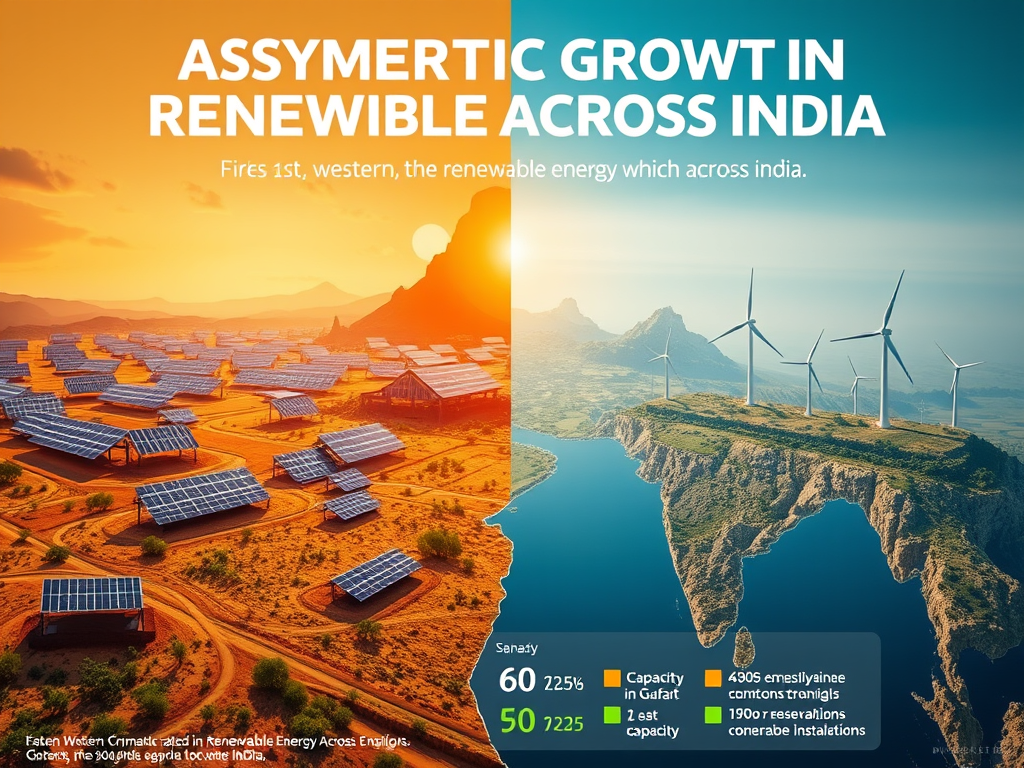
A distinct “RE divide” has emerged, effectively splitting India into high-performing western/southern states and lagging eastern/northern counterparts. As of December 2025, Gujarat has overtaken Rajasthan to become India’s leading state in total renewable capacity, boasting 42.58 GW of installed capacity.

The disparity is structural rather than accidental. Gujarat’s ascendancy stems from its balanced portfolio: it ranks first in wind energy (14.82 GW) and second in solar (25.53 GW). In contrast, Rajasthan’s growth is lopsided, heavily reliant on solar power (22.86 GW) while lagging in wind deployment.
The “Leader States”—Gujarat, Rajasthan, Tamil Nadu, and Karnataka—benefit from three critical enablers.
- Land Availability: Rajasthan’s vast barren tracts in the Thar Desert allow for mega-projects like the Bhadla Solar Park.
- Grid Infrastructure: Gujarat’s robust intra-state transmission network (InSTS) minimizes curtailment, whereas states like Tamil Nadu historically faced curtailment issues due to grid congestion.
- Policy Stability: Gujarat’s hybrid policy effectively incentivized wind-solar co-location, maximizing land use efficiency
Conversely, “Laggard States” in Eastern India face land acquisition hurdles and lower solar insolation levels. The concentration of RE assets in the West necessitates an urgent upgrade of the Green Energy Corridor (GEC) to transport power to load centers in the North and East.
Sectoral Split: Solar’s Sprint vs. Wind’s Stagnation
The divergence between solar and wind energy expansion is widening. Solar capacity has grown exponentially, crossing the 100 GW mark in January 2025 and reaching 140.6 GW by January 2026. In comparison, wind energy capacity stands at 54.65 GW, growing at a significantly slower pace.

- Land Saturation & Repowering: The most wind-rich sites (Class I sites) in Tamil Nadu and Gujarat were claimed decades ago by low-capacity turbines (<1 MW). Repowering these sites with modern 3 MW+ turbines is stalled due to “fragmented ownership,” where a single wind farm has multiple owners, making land lease renegotiations legally complex.
- Supply Chain Constraints: The sector faces acute shortages of transformers and high-voltage switchgear, with lead times stretching to 20 months
- Offshore Failures: The Solar Energy Corporation of India (SECI) cancelled major offshore wind tenders (4 GW seabed lease) in August 2025 due to viability concerns and lack of developer interest, further dampening sentiment.
Policy Recommendations
To address these structural imbalances and accelerate the path to 500 GW, the Ministry of Power and MNRE must implement the following interventions.
- Enforce a “Repowering Aggregator” Framework: The current National Repowering Policy is voluntary and ineffective due to fragmented ownership. The government must mandate state nodal agencies (like GEDA or TANGEDCO) to act as “Aggregators.” These agencies would pool land from multiple small turbine owners, auction the repowering project to a single developer, and distribute revenue shares, thereby bypassing the deadlock of individual negotiations.
- State-Specific Renewable Purchase Obligations (RPO) with Penalties: The disparity in RE deployment allows non-compliant states to free-ride. The Ministry of Power must strictly enforce the new RPO trajectory under the Energy Conservation Act, 2001. Penalties for non-compliance must be levied on DISCOMs in lagging states to force them to procure RE certificates or power from renewable-rich states, driving demand for the Green Energy Corridor.
- Incentivize Behind-the-Meter Storage: With solar capacity causing a sharp “duck curve” in grid demand, mere generation is no longer the metric of success. The MNRE should introduce a Production Linked Incentive (PLI) specifically for “Distributed Storage” (BESS) co-located with existing solar parks in Rajasthan and Gujarat. This will reduce curtailment (currently 10-30% in high-RE states) and ensure power availability during evening peaks.
Conclusion: From Asymmetry to Alignment
The data from 2025 sends a clear signal: India’s renewable energy revolution is aggressive but increasingly asymmetric. While the nation is firmly on track to meet the 500 GW non-fossil fuel target by 2030, the heavy reliance on just two states—Gujarat and Rajasthan—creates a “single point of failure” risk for the national grid. The widening gap between solar’s exponential growth and wind energy’s stagnation is equally concerning, threatening the grid’s balancing capability during non-solar hours. For the Panchamrit goals to be realized, the Ministry of New and Renewable Energy (MNRE) must pivot from a “capacity-first” approach to a “balanced-growth” strategy. This requires unlocking the wind sector through a mandatory Repowering Framework and forcing laggard states to share the burden via strict RPO enforcement. The “Era of Duty” (Kartavya Kaal) must extend to state DISCOMs; the transition cannot be subsidized solely by the grid infrastructure of Western India. Unless these structural fault lines are addressed, India may reach 500 GW, but it will be a grid divided against itself.