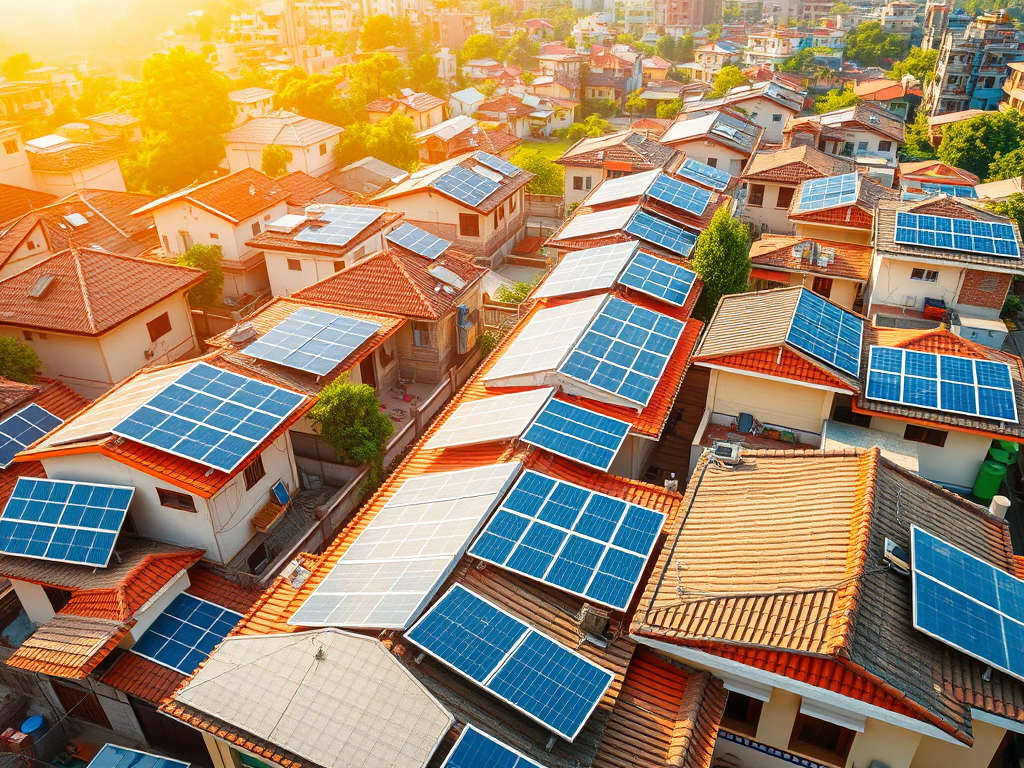
The PM Surya Ghar: Muft Bijli Yojana, launched in February 2024, promotes rooftop solar on one crore households by 2026–27, supporting India’s renewable energy goals and reducing electricity costs. The scheme provides tiered subsidies, free electricity, low-interest loans, and digital monitoring. By December 2025, 2.08 million systems were installed, though adoption varies across states due to procedural delays, grid limitations, and vendor shortages. Success depends on streamlined approvals, expanded vendor networks, targeted awareness, and performance-linked funding to ensure equitable, large-scale rooftop solar deployment.
Background
India’s rapidly growing urban power demand, rising carbon emissions, and international climate commitments have intensified the need to expand clean energy capacity. These pressures are closely tied to national renewable-energy targets, including achieving 500 GW of renewable capacity by 2030, sourcing 50 % of total energy demand from renewables, and steadily reducing carbon intensity across sectors. Within this transition, rooftop solar plays a dual role: it advances environmental goals while also improving household affordability by lowering electricity bills and reducing dependence on centralized grids during peak demand periods. Against this backdrop, the PM Surya Ghar: Muft Bijli Yojana (Figure 1) was launched on 13 February 2024 by the Government of India to accelerate rooftop solar adoption in the residential sector. The scheme is designed to promote household-level energy self-sufficiency, reduce monthly electricity expenditure, and decentralize power generation. It sets an ambitious target of installing rooftop solar systems on one crore households by FY 2026–27, supported by a substantial budget outlay of ₹75,021 crore, signalling a strong fiscal and policy commitment toward distributed renewable energy expansion.

Key Features of the Yojana
- Central Financial Assistance (CFA): Tiered capital subsidy structure, up to 60 % support for systems up to 2 kW, and 40 % for additional capacity between 2–3 kW, with the subsidy capped at 3 kW per household. This design prioritizes affordability for small and middle-income households while encouraging optimal system sizing.
- Free Electricity Provision: Participating households can generate up to 300 units of electricity per month through rooftop solar, substantially lowering or eliminating monthly electricity bills depending on consumption patterns and local tariffs.
- Affordable Financing Options: Access to collateral-free, low-interest loans through partnered financial institutions helps reduce upfront installation costs and improves accessibility for lower- and middle-income households.
- Digital Implementation & Monitoring: The scheme operates through a centralized national portal that enables households to register, select empanelled vendors, apply for subsidies, track installation progress, and manage net-metering approvals, improving transparency and administrative efficiency.
- Long-Term Co-benefits: The programme is projected to add 30 GW of rooftop solar capacity, generate 1,000 billion units of electricity over a 25-year system lifecycle, avoid 720 million tonnes of CO₂ emissions, and create large-scale employment across manufacturing, installation, and maintenance value chains.
National Uptake and Comparative State Performance
As of Dec 2025, over 2.08 million rooftop solar systems installed nationwide under PM Surya Ghar, benefitting 2.61 million households with ₹14,771.82 crore in CFA disbursed. Table 1 below reflects cumulative progress across States and Union Territories in terms of applications received, households benefitted, Central Financial Assistance (CFA) released, and critical enablers or barriers. These indicators together help assess both demand-side interest and actual scheme conversion.
| State/UT | Application (Nos) | Households Benefitted (Nos) | CFA Released (in Crore) | Contributing Factors |
| Andhra Pradesh | 1164150 | 16556 | 79.92 | Conversion limited by procedural delays and financing/approval bottlenecks |
| Arunachal Pradesh | 94 | NA | NA | Difficult terrain and weaker grid infrastructure constrain |
| Assam | 304859 | 10142 | 52.45 | Grid constraints, lower average incomes, and limited installer ecosystem |
| Bihar | 70919 | 4971 | 23.61 | Low incomes, credit constraints, and limited awareness/installer presence |
| Chhattisgarh | 37351 | 2299 | 7.58 | Growth influenced by administrative capacity and consumer awareness |
| Goa | 4511 | 828 | 2.87 | Relatively affluent consumer base with good awareness. |
| Gujarat | 399351 | 404464 | 2031.43 | Long-standing rooftop-solar ecosystem, proactive DISCOMs, clear net-metering framework, and strong installer/financing network |
| Haryana | 166338 | 21600 | 96.75 | Rooftop suitability and procedural delays temper faster growth |
| Himachal Pradesh | 6358 | 1673 | 8.99 | Hilly terrain and dispersed habitations increase costs and technical complexity |
| Jharkhand | 7138 | 261 | 1.27 | Patchy grid quality, and a thin installer/financing ecosystem limit rooftop adoption. |
| Karnataka | 215785 | 10127 | 43.22 | Strong urban centres, and prior rooftop-solar experience support uptake, though approval and grid-integration issues can slow deployment |
| Kerala | 128910 | 80856 | 492.06 | Dense urban housing stock, and earlier state rooftop schemes support strong adoption |
| Madhya Pradesh | 62465 | 31086 | 189.85 | Mid-tier adoption shaped by urban-rural income gaps and financing access |
| Maharashtra | 568346 | 247610 | 889.14 | Large urban/peri-urban base, and established installer market drive strong adoption, moderated by DISCOM |
| Manipur | 772 | 220 | 1.31 | Difficult terrain, dispersed loads, and limited installer presence constrain rooftop numbers |
| Meghalaya | 2050 | 18 | 0.08 | High rainfall and complex terrain, grid challenges, and a small urban base keep adoption low |
| Mizoram | 666 | 129 | 0.73 | Hilly terrain, scattered settlements, and modest incomes constrain rooftop solar. |
| Nagaland | 245 | 8 | 0.05 | Dispersed, challenging terrain, and limited financing/installer infrastructure restrict scheme uptake |
| Odisha | 95079 | 3193 | 16.13 | Cyclone-prone grid and moderate incomes limit scale |
| Punjab | 14704 | 5385 | 31.58 | Smaller residential base and procedural frictions yield moderate, steady rooftop growth |
| Rajasthan | 229852 | 33872 | 207.34 | Rooftop expansion shaped by urbanisation and DISCOM processes |
| Sikkim | 58 | 4 | 0.02 | Limited suitable rooftops and higher installation costs keep numbers low |
| Tamil Nadu | 83500 | 29211 | 141.16 | Strong grid and high appliance use make savings attractive but regulatory complexity moderate the pace of household adoption |
| Telangana | 46585 | 13677 | 55.23 | Growing urban base and state promotion support steady uptake, along with improving installer and DISCOM capacity |
| Tripura | 3533 | 168 | 0.89 | Remote location, small consumer base, and logistics/installer constraints limit scheme penetration |
| Uttar Pradesh | 1050448 | 95842 | 550.68 | Conversion is slowed by documentation, financing, and DISCOM-process bottlenecks |
| Uttarakhand | 47004 | 19767 | 125.78 | Mountainous terrain constrains some areas, but awareness and targeted promotion help it outperform many small hill states |
| West Bengal | 26787 | 459 | NA | Regulatory frictions, and slower policy alignment result in relatively low rooftop-solar penetration so far |
| Andaman and Nicobar Islands | 176 | 17 | 0.06 | High diesel-generation costs, logistical constraints for equipment transport, strong economic case where systems are actually installed |
| Chandigarh | 1377 | 641 | 1.8 | Apartment ownership patterns and net-metering rules shape residential uptake |
| Dadra and Nagar Haveli and Daman and Diu | 1625 | 136 | 0.48 | Adoption shaped by small consumer base and limited installer ecosystem |
| Jammu and Kashmir | 33521 | 2597 | 9.22 | Challenging terrain and climatic conditions, plus grid and financing constraints |
| Ladakh | 692 | 346 | 2.48 | Extreme climate, sparse population, and high logistics costs constrain large-scale roll-out |
| Lakshadweep | 718 | 261 | 1.73 | Island geography and very small consumer base limit total numbers |
| Delhi | 8409 | 3251 | 6.99 | Complex multi-storey housing, roof-access issues, and regulatory processes affect adoption |
| Puducherry | 1451 | 745 | 4.41 | Adoption influenced by limited population size and building-ownership patterns |
| Total | 4785827 | 1042420 | 5077.27 |
Studies show that top performers like Gujarat, Kerala, Uttarakhand, Andhra Pradesh, Maharashtra and Uttar Pradesh combine strong institutional capacity, efficient DISCOMs, high digital and financial literacy, and active vendor–DISCOM coordination to convert registrations into installations and subsidy releases. The same work finds that bottlenecks arise at early stages due to institutional frictions, awareness gaps, and process complexity. Low-performing regions such as West Bengal and Arunachal Pradesh score poorly due to administrative inertia and limited institutional drive and structural barriers. Additionally, persistent conversion gap remains because many applications logged on the national portal have not yet translated into completed rooftop systems, mainly due to delays in site inspections, net metering approvals, and shortages of empanelled vendors. Finally, equity and access barriers mean that smaller states and Union Territories often see lower uptake because they have fewer awareness campaigns, thin vendor ecosystems, and weaker local financing networks, so structural constraints slow adoption even when central funds are available.
Policy Recommendations
Given the observed disparities in state performance and persistent conversion gaps, a multi- pronged policy approach is required that addresses administrative efficiency, financing access, vendor capacity, and consumer awareness simultaneously. To maximise the impact of PM Surya Ghar Yojana and India’s rooftop solar potential the government should.
- Strengthen local implementation support: Further digitise net-metering approvals, inspections and meter testing to reduce early-stage bottlenecks in registration, application and installation. Streamlined and standardised local processes improve predictability for both households and vendors, increase trust in the scheme, and help DISCOMs manage higher application volumes without administrative backlogs.\
- Expand commercial and government sector targets: Set clearer targets and tailored incentives for government, commercial and institutional rooftops, including streamlined approvals, so larger roofs can add capacity quickly and support local grids. This approach also creates visible demonstration effects, stabilises local grids through distributed generation, and provides steady demand that supports installer markets and supply chains.
- Amplify awareness and vendor networks: Fund sustained consumer-awareness campaigns, handholding support and structured training or accreditation for installers in under-adopting states such as Assam, Telangana and Haryana. Expanding accredited vendor networks in under-adopting states improves service availability, reduces installation wait times, and builds local technical capacity, which together increase both confidence and participation rates.
- Support complementary state policies: Encourage state governments to top up central subsidies with state rebates, concessional finance and targeted support for low- and middle-income households so upfront costs fall and participation becomes more equitable. When state-level incentives align with national objectives, adoption becomes more equitable across income groups and regional disparities in rooftop solar penetration can be reduced.
- Introduce need based and performance linked CFA allocation mechanisms: The large variation in state wise CFA disbursement, often exceeding what would be expected from differences in state size or population alone, indicates uneven fund absorption capacity and implementation efficiency across regions (Graph 1). Adopting an allocation approach that considers application to installation conversion rates, vendor capacity, grid readiness, and household income profiles can improve both equity and utilisation of funds. Linking a portion of CFA releases to measurable performance outcomes would encourage faster approvals and higher completion rates, while maintaining a minimum need based allocation for smaller or capacity constrained states would prevent persistent underfunding despite genuine demand. This balanced approach can reduce regional disparities and ensure that financial support more closely reflects both potential and actual progress in rooftop solar adoption.

Conclusion
The PM Surya Ghar: Muft Bijli Yojana represents a significant step toward decentralised clean energy adoption in India by linking household affordability with national climate and energy security goals. Early progress demonstrates strong public interest and measurable capacity addition, yet state-wise performance differences highlight that financial allocations alone are insufficient to guarantee uniform outcomes. Institutional efficiency, vendor availability, grid readiness, public awareness, and financing access emerge as the decisive factors shaping whether applications translate into completed rooftop installations. Going forward, the scheme’s long-term equitable success will depend on reducing procedural delays, strengthening local implementation capacity, and ensuring that financial support mechanisms are both equitable and performance oriented. If these adjustments are sustained, PM Surya Ghar has the potential not only to expand rooftop solar capacity at scale but also to embed distributed renewable energy as a reliable and inclusive pillar of India’s energy transition.